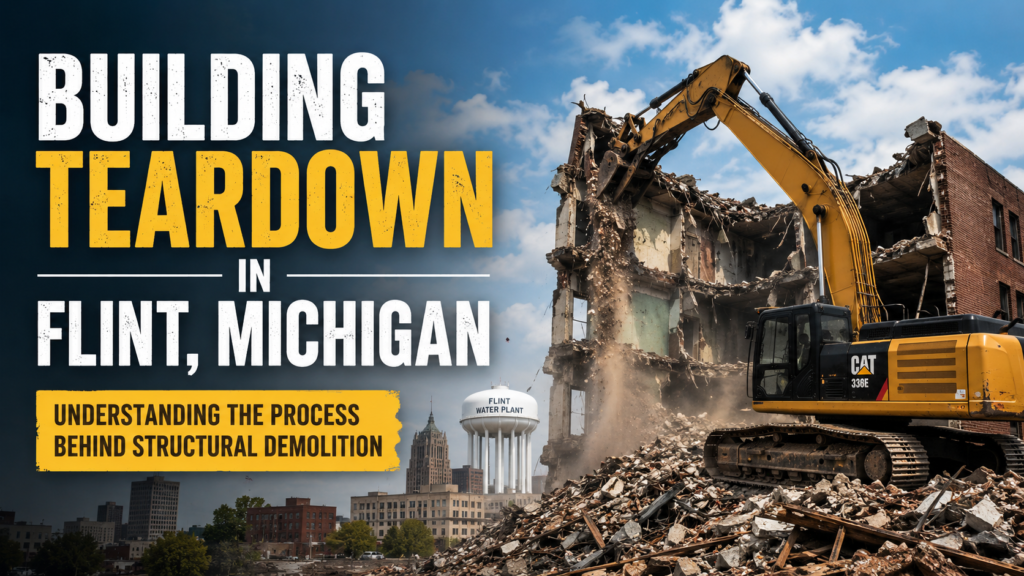
Building teardown, the complete removal of a standing structure to clear land for new use, is one of the most consequential and most visible services in Flint, Michigan ongoing urban revitalization. The Genesee County Land Bank Authority has demolished more than 8,400 blighted structures in Flint and Genesee County since 2004, with thousands more slated for removal through ongoing American Rescue Plan Act funding, Charles Stewart Mott Foundation grants, and other sources. But building teardown is not limited to publicly funded blight removal programs. Private property owners, developers, and businesses in Flint also regularly require teardown services for renovation projects, site redevelopment, and property improvement. Understanding what Building Teardown Flint involves helps anyone planning such a project approach it with realistic expectations.
What Building Teardown Means
Building teardown, also called structural demolition or building removal, is the controlled, planned removal of an entire building structure. It is distinct from interior demolition which strips a building interior while preserving its shell, and from selective structural demolition which removes specific structural components while retaining others. Full teardown results in a cleared site from which every above-ground structural element has been removed and from which the foundation, underground utilities, and grade are prepared for the property next intended use. In Flint context, teardown addresses residential structures including single-family homes, duplexes, and multifamily buildings that comprise the majority of blighted and vacant properties throughout the city, as well as commercial, industrial, and institutional structures.
Pre-Teardown Planning and Requirements
No building teardown in Flint can responsibly begin without a comprehensive pre-demolition process covering both legal requirements and practical safety preparation.
- Building inspection and structural assessment. The structure is assessed for its construction type, materials, condition, and any structural features that affect the safe demolition sequence. Many older Flint structures have masonry load-bearing walls, steel-reinforced concrete, or construction characteristics from earlier eras that require specific sequencing.
- Asbestos survey and abatement. Michigan and federal regulations require that structures slated for demolition be surveyed for asbestos-containing materials by a licensed inspector before teardown begins. Flint building stock includes a significant proportion of pre-1980 structures where asbestos was used in insulation, floor tile adhesives, ceiling materials, roofing, pipe insulation, and textured coatings. When ACMs are identified, licensed abatement contractors must remove and properly dispose of them before structural demolition proceeds.
- Lead paint assessment. Pre-1978 structures contain lead-based paint requiring specific handling under EPA Renovation, Repair, and Painting rule. Dust control measures including water suppression during demolition help prevent lead dust from spreading to neighboring properties.
- Utility disconnection. All utilities serving the structure must be formally disconnected and confirmed before structural teardown. This means coordinating with DTE Energy, Consumers Energy, and the City of Flint water and sewer department.
- City of Flint demolition permit. The Building Inspection Department requires a demolition permit for structural teardown within city limits. The permit confirms utility disconnection and ensures the project is on the city radar for inspection and code compliance.
The Physical Teardown Process
With pre-demolition requirements met, the physical process in Flint follows a defined sequence. The work area is secured with appropriate fencing and dust suppression equipment is prepared, typically water hoses spraying the structure during demolition to control particulates. An excavator with demolition attachments systematically dismantles the structure from the roof down in a sequence that maintains structural stability as elements are removed. As the structure comes down, material is sorted to the extent practical, metals separated for recycling, concrete broken for recycled aggregate, and remaining mixed debris loaded into haul trucks for permitted disposal facilities. The Genesee County Land Bank requires that debris be loaded expeditiously once a structure is demolished to maintain site security and prevent dumping.
Foundation and Site Work
After structural demolition and debris removal, the foundation of the demolished structure is addressed based on the planned future use of the site. For sites intended for new construction, foundation removal is typically required, the concrete broken up and crushed for recycling as aggregate. For long-term open parcels, partial fill of the foundation void with compacted clean fill may be appropriate. The site is then rough graded to establish positive drainage, preventing standing water that would attract pests and create erosion. Erosion control seeding or sod stabilizes the disturbed soil surface. The Genesee County Land Bank uses Dutch White Clover seed after residential demolitions, which germinates quickly, fixes nitrogen in the soil, and provides pollinator habitat while reducing long-term maintenance costs.
Building Teardown in Flint Revitalization Context
Flint building teardown activity is embedded in a larger narrative of urban revitalization. The city blight elimination programs have removed thousands of structures that were safety hazards, harbors for criminal activity, and visual blights suppressing property values. Removal followed by appropriate site restoration converts neighborhood liabilities into assets. For private property owners in Flint planning teardown projects, the city regulatory framework and the county extensive experience with large-scale demolition programs mean that the support infrastructure including permit offices, asbestos inspectors, abatement contractors, demolition contractors, and disposal facilities is well-developed and experienced with this work.
Conclusion
Building teardown in Flint is a structured, regulated, and community-significant undertaking that requires careful pre-demolition planning, compliance with asbestos and lead paint requirements, proper utility disconnection, skilled mechanical demolition, and thoughtful site restoration after the structure is removed. Understanding what the process involves gives property owners, developers, and community stakeholders realistic expectations and an appreciation for the professional work that responsible building teardown requires in one of America most actively revitalizing cities.